West Oz
Western Australia has a third of the continent's total area yet houses less than 10 percent of the country's total population. This place has space. Surfing started in Perth in the 1950s before surfers realized the swell was blocked to the city beaches by Rottnest Island nine miles offshore. In the 1960s, they started venturing south, eventually discovering the waves south of Cape Naturaliste. Once they saw the potential of the Margaret River region, they never left. Since then, so much more of this region’s huge (2200-km/1600-mile) coastline has been revealed — yet so much still remains to be explored.
The Waves
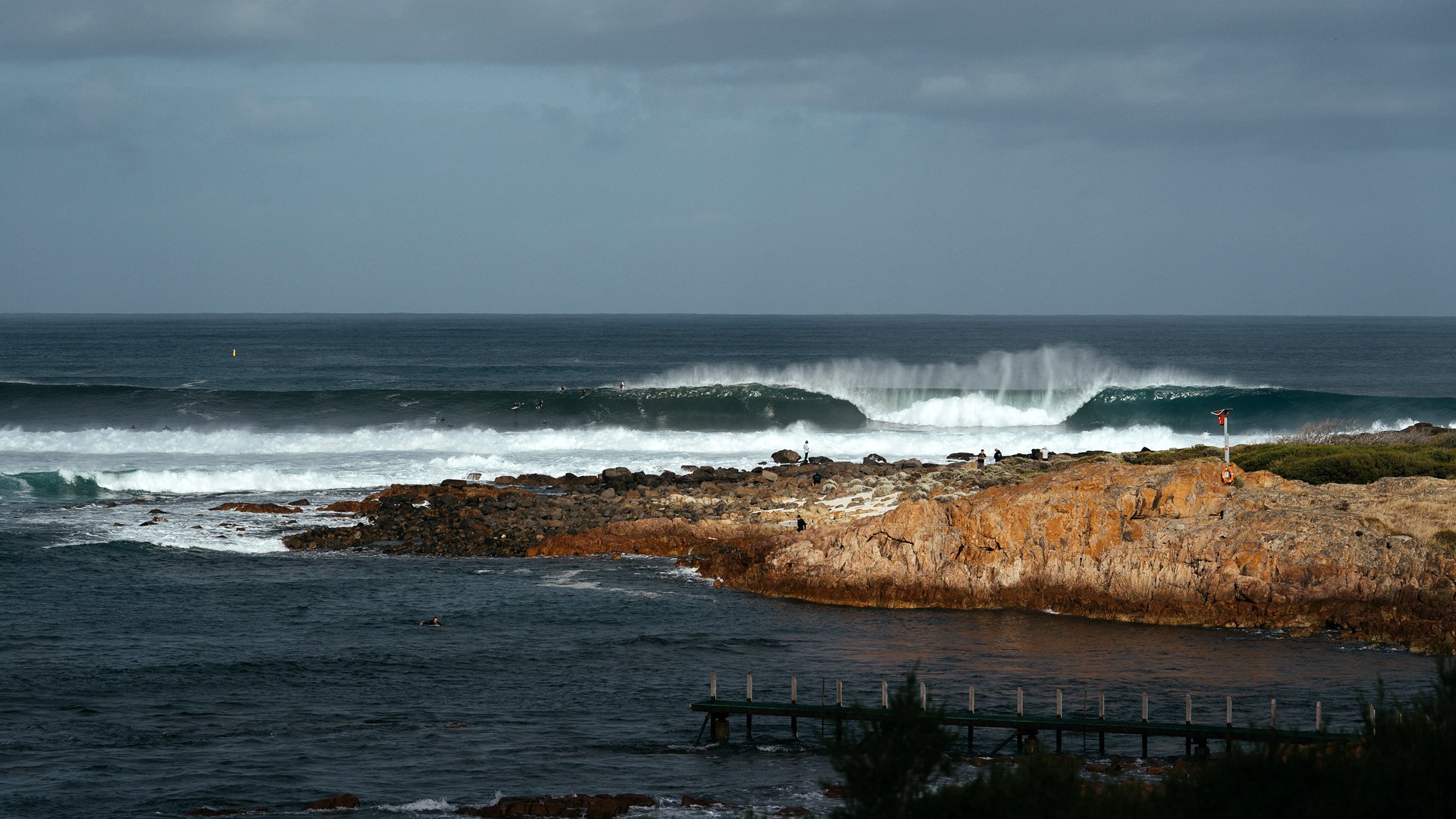
North Point
You've probably seen pics of this place. It's one of the most photogenic in the region. Photographers can get tight shots from the rocks or swim into the channel and snap aspiring professionals pulling into the outside death section, hoping the resulting spread in a surf mag will pay enough to cover the costs of the ambulance ride back to the hospital in Margaret's or Busselton if they fall off. Even Taj Burrow is slave to this wave's whims. He copped one of the worst wipeouts of his life here when an eight-footer slapped him headfirst into the rocks below, exposing his skull and requiring major stitching. Nevertheless, serious chargers drive from Perth to surf this place when it's on (which isn't often). There are two sections: the outside pit, which looks reasonably makeable from the take-off, then the shallow inside section. Making both takes huge balls and a lot of skill. Seriously good surfers rule here, taking off deep and gunning a high line through one of the heaviest barrels in WA, leaving only the odd scraps for the lids and lesser surfers who clamber over it from the safer take-off spots. Don't want to risk it? Join the crowds on the point and enjoy the action.

Margaret River
This place is the business. Goofy or natural, a couple of lefts here during a solid 6-8ft swell will be burnished on your brain for decades. Paddling with the pack towards an incoming set and realizing that you - yes, you - are best positioned to spin and take off is one of the most amazing feelings you will ever have as a surfer. The drop looks heavy and the wall looks long, but cast your doubts aside and go. At this size, the wave gives you an extra moment or two before it pitches, by which time you will be at the bottom, lining up one of the smoothest, fastest turns you will ever do along a solid face, even when it's onshore. If you're lucky, you'll follow this with a pit through the inside section. If the place makes you a bit nervous, that's OK. Sit wide and watch what happens. If the crowd isn't too heavy, you will be able to sneak in and grab a couple of smaller ones, which the crew out the back don't even look at. But be prepared to cop a set on the head. It'll happen. Just don't be rattled. There's something awe-inspiring about the waves here, but they're not lethal. As for the right-hander, one look at it from the carpark will tell you all you need to know: don't ride too close to the dry reef on the inside. If there's a set behind when you pull out, you're in trouble. Ending a session here is fun, too. Keep cutting back into the white water, and you can ride along the edge of the reef for a couple of hundred meters, doing the little hotdog turns the waves outside wouldn't let you.

Yallingup
For a wave favored by older surfers and longboarders, this place can turn on a bit of intimidation. It's only worth surfing over four foot, and best when it's six foot plus. At that size, there's nowhere to hide when long-line sets charge into the line-up, mowing down anyone caught too far inside. You won't hit the bottom (unless you're caught inside on the right-hander), but the undiluted power of the place is going to hold you down for a while. But sit far enough out and have the board volume or arm strength to catch one of these beasts, and you will find yourself in command of a long, charging wall, peeling easily into a long deep channel on the left, or throwing fast sections on the right, which eventually closes out in front of dry reef. For intermediate surfers, this is the safest way to get a taste of pure power. You don't need a lot of skill to keep up with the left, but you'll still get a chance to bury a rail on a serious bottom turn if you want to. Advanced surfers know that if Yal's is on, there is some seriously better gear going down elsewhere. Have a photo for this break? Send it over!

Injidup Carpark
One of the main factors here is the crowd. Locals from Yallingup, and a few from Gracetown and Margaret's, descend on it like flies when it's on (which is often). Jostling in the take-off zone can get a bit frisky. If you're not into that shit, sit a bit wide and pick off the occasional set wave that leaves the pack too deep, scrounge the smaller insiders, or go the left, which isn't as good as the right but still fun. Snaffle a decent set wave, and you'll learn what the fuss is about. This wave is one of the best around. There's a tight but makeable pit on low tide, and a wall that will give you two or three big hits before you play your cadenza on the closeout near the shore. When it's medium size, it's got the feel of a slightly serious beachbreak. When it's big, it assumes the full southwest WA menace. Either way, it's a reliable right-hander, picks up any swell that's going, and doesn't vary much from tide to tide. If it's too crowded, have a look a bit further afield. Big SW swells can wrap into the point, where there is a long left, but it gets a bit shifty, and there's a rock shelf in the middle that can catch you by surprise.

Smiths Beach
This is the southwest coast's original ledge, a left and a right. Back when the region was known for its long, walling waves like Margaret's and Yallingup, surfers looking to avoid the crowds started pushing their single-fins over this shelf at high tide and reaping the rewards with high-speed top turns, barrels or just a fast, smooth slingshot across the dredging reef. The reason it was such an early training ground for what is now standard wave-riding is the sweet spot in the reef that gives a good surfer an early drop into the wave before the whole thing jacks up. It's not deep enough to be a back door, but it can set you on an amazing line. It's OK on low tide if it's less than three feet, any bigger and you'll have to wait for the incoming. The bank next to the reef rarely disappoints. Once you clear the spooky dark shallows over the reef and hit the clear emerald green of the sandy channel, you'll be so stoked that you're likely to throw down a big hack, just to celebrate. And the closing section on the inside offers big hits to anyone prepared to do a couple of duck-dives to get back out. Have a photo for this break? Send it over!


Scarborough
In winter, when the onshores blow for more than a couple of days, this beach can crank. Swells from the SW or NW aren't blocked by Rottnest Island, and when they hit Scarborough's relatively steep banks they can pack a punch. Most of the time, though, it's an average beachbreak, albeit one with banks spread along a couple of kilometres (the whole stretch goes from Brighton in the south, to Scabs, Contacio, and Trigg). This is Perth's equivalent of Manly, in Sydney. Decent waves, too crowded to have a local crew, a smattering of travellers and backpackers, and a bit of nightlife when the sun goes down. The only stars to emerge from here are Ian Cairns in the 1970s, and Dave Macaulay in the 1980s. Since then, the crowd has gone a bit quiet, and you get that feeling in the water. It's a pretty mellow place. It used to be a fairly hard-core surfer hangout, but since Alan Bond knocked over all the old pinball joints and hamburger bars so he could dump Observation City on the main drag, it's lost its vibe. That doesn't change the wave, though. Have a photo for this break? Send it over!

Gas Bay
Get a taste of the spirit of adventure for which this area was once known. Gas Bay is at the end of a narrow road south of Margaret's. Once you've parked, you need to walk a fair way across a sandy bay and over the rocks on the far side. It's a bit of a hike, but with each step, the feeling that you're leaving the crowds and conveniences of lesser urban breaks behind, and reacquainting yourself with something a bit freer, grows. The wave is a right-hander with a super-sucky take-off over rocks followed by a sandbank going to the beach. Getting shacked is a doddle for naturals, and not too hard for skilled goofies. The other right-hander in the area is Grunters, which is on the point near the carpark. Handles anything from 4-8ft. Some of its sections pack a lot of power, although on any given day it's not quite as heavy as Margaret's main break.

The Bluff
I'm going to argue that this is the most stunning surf spot in the world. Not the best (but not far off it), not the most consistent, not the heaviest, just the most goddamn beautiful. Spend two weeks in one of the lux exo-tents, surfing the long backlit tubes and retiring post-session to your deck with an icy Swan Lager and you'll feel as if you're living in some heavenly afterlife. Bliss. To find it, it's 100 km north of Carnarvon. Take the Blow Holes turnoff.

Gnaraloo
Like most classics, no one was ever going to be able to keep Gnaraloo a secret. One hundred miles north of Carnarvon, the wave is a quarter-mile-long left-hander that features outrageously shallow step-filled barrels and endless rippable walls. And all before the watchful eye of hundreds of sharks. You're a long way from medical help here, so pack well, surf sensibly, and keep your eyes on your buddies. Have a photo for this break? Send it over!

Jake's Point
Six hours drive north of Perth is Kalbarri, home to the jacking lefthander Jakes Point. Jakes is one of those idiosyncratic waves that are absolutely owned by the local surfers. Unless you're at WCT level or you've come from Teahupo'o, you won't dominate or even catch sets on a good day.( Ry Craike and Kerby Brown are two brilliant young Australian surfers who live and surf here.) But, like most reefs, Jakes breaks from two foot upwards. And the tough fishermen who populate this picturesque desert town don't wanna touch it when it gets small. Time for you -- time for me -- to shine. Have a photo for this break? Send it over!

If you want fun smaller surf, summer is for you. Otherwise, winter means bigger boards and thicker wetties.

When to Score & Seasonal Surf Data
Know exactly when to score — powered by our expert historical forecast data.
Decades of spot-specific swell info — combined with forecaster insights — show your best chance to score, found only on Surfline.
Time to score

Forecaster reports
Seasonal Surf Data

Southwest Australia According To...
Imogen
Caldwell
Hard-charging Aussie freesurfer breaks down the wild west.
What makes Western Australia a special destination for surfers?
There's an abundance of waves, a good range—big or small—there’s something to suit everyone.
What kind of waves can visiting surfers expect?
Obviously, it depends on the weather, swell and such…but generally, the waves on the West Coast are quite powerful compared to the East Coast of Australia.
What’s the vibe—crowded, mellow, aggressive, friendly?
All of the above. Depends on which location you go to. Some spots are heavily localized, others are not.
What should surfers bring?
A lot of boards because you'll probably break a few. Everything from a big-wave board to a groveler depending on what kind of waves you’re after.
When is the best time to score?
If you want fun smaller surf, summer is for you. Otherwise, winter means bigger boards and thicker wetties. I hear O'Neill do the best cold-water suits.
What else is there to do when you’re not surfing?
WA has so much to offer. Exploring the state would take you a lifetime.
What’s your favorite local cuisine?
The Indian Ocean is rich in seafood. We eat a lot of fish and crayfish.
Where can people learn to surf?
Most of the surf schools are in Perth but you can find them in the southwest region as well.
What are some things people should be aware of when it comes to local culture and customs?
Be respectful and wait your turn.
What’s the number one thing folks should keep in mind when traveling through the area?
Kangaroos are on steroids over here, especially at dawn and dusk.
Any other local tips?
When it’s solid, don't be a hero. Surf within your ability.
Travel Essentials

Culture & customs
West Oz is a place of extremes – from the widespread natural beauty (blending both fiery red deserts and crystalline blue oceans) to the wildlife (kangaroos, dolphins, whales and, yes, sharks) to the waves (big, heavy, dangerous) to the extracurricular activities (some of the best wine tasting in the world, coupled with any adventurous activity you can think of). And yet, conversely, the people are quiet, humble, easy-going…but there’s still a wild side to ‘em. Many folks in this part of the country are working-class – hence the humble mentality – yet they surf with power and confidence required for their homeland’s caliber of waves.
Local scene
It’s difficult to grasp the variety of surf zone and coastal breadth of this region. There are city beaches in Perth, with smaller waves and plenty of people hoping to ride them when they show. There’s the temperate forest coasts of the Margaret River region, with its many reefs and beach-breaks, and waves of every possible kind. Then there’s the long range desert surf zones to the north — big, broad, and epic, many of which are campsite only. This means a huge variety among the surfing populations of each, which is part of the beauty of the place. One thing’s for sure, you’ll see a lot of great surfers wherever you go, most of them won’t be famous, and pretty much all will be friendly and open for conversation with a visitor.
What to bring
Given the power and nature of the waves, you’ll need a mix of normal shortboards, step-ups and guns. Board breakage is an everyday occurrence, so you’ll need a bigger quiver than usual. The water isn’t warm or cold, so a 3/2 steamer is the wetsuit most in use during the prime autumn months.
Also: Our amazing partners over at FCS have curated a collection of fine products for your next surf trip. Check it here.
How to get there
West Oz is a massive chunk of a massive country. It encompasses nearly a third of Australia as a whole, so you're gonna need some wheels. After flying into Perth, it’s about a three-hour drive south to the surf haven of Margaret River. If you’re headed north, it’s around a six-hour drive to Kalbarri, maybe nine to Red Bluff, and a whopping 11 hours to Gnaraloo. If you’re going to move around outside of Perth or the Margaret River hub – which you totally should — have your playlists, podcasts, or books on tape all queued up for the rugged drive.
Downtime
The fertile southwest corner is home to the Margaret River wine region, and a tour of the world-renowned wineries is a must. In the far north, the Kimberley region is home to ancient First Nation people's rock art, the Bungle Bungle sandstone domes, Broome, Cable Beach camels and the pearling industry. Near the desert waves of Red Bluff and Gnaraloo is Ningaloo Marine Park, a UNESCO World Heritage-listed reef where you can swim with whale sharks, manta rays, turtles and humpback whales. The capital of Perth, based on the Swan River, adds the only element of cosmopolitan sophistication to this otherwise all-natural state.
Quick Tips
Travel Time
LAX: 19 hrs
JFK: 24 hrs
Heathrow: 18.5 hrs
SYD: 5.5 hrs
Connectivity
WiFi available at coffee shops, hotels, and businesses in populated places like Margaret River. But once you venture off into the wilds of West Oz, be prepared to go off-the-grid.
Currency
Australian Dollar. At the time of writing, $1 USD = 1.41 AUD
Avg. cost of...
Cup of coffee: $3.00
Lunch: $15.00
Beer: $7.00
Hotel room: $100.00
Visa Requirements
Yes. A visa is required to visit Australia for 90 days or less. A fee may be applicable depending on what type of travel you intend to do (business or holiday) and how long you plan to stay.
Drinking water quality
Some of the cleanest in the world.
Hazards
Encounters with wildlife (watch out for the kangaroos), bumpy dirt roads, localism, paddling out in conditions beyond your ability, breaking all your boards.
Cash, card, crypto
Credit cards are widely accepted, and access to ATMs is available…until you drive off-the-grid.


Have feedback on this zone? Let us know [email protected]
Questions about booking with Surfline Travel? Check out our FAQs